2023- ongoing
View
This project examines the ways in which feminist ideas forged during the French Enlightenment harnessed inspiration from indigenous thought, at the onset of French colonial expansion in the Eastern Woodlands. Addressing patriarchy in light of Iroquois culture, the film to realize is an exercise in speculative history that stages a dialogue between a Haudenosaunee[i] and a French 18th century woman. A publication and a constellation of other works, conceived as the inquiry and immersion proceeds, are comprised in this undertaking.
I am currently conducting this project as a Fulbright scholar, hosted by Center for Global Indigenous Cultures and Environmental Justice –Syracuse University (New York State). My stay in Syracuse concerns my interlocution with indigenous thinkers and leaders at the Onondaga nation (Syracuse, NY) which is the heart of the Haudenosaunee Confederation. The Onondagas, or People of the Hills, are the keepers of the Central Fire and are the spiritual and political center of the Haudenosaunee. The Onondaga Reservation is a politically independent entity, federally recognized by the United States Government.
Moreover, I am forging collaborations with relevant native women from other Haudenosaunee nations like Louise Wakerakats:se Herne, (Kanien’keha:ka), a Mohawk Bear Clan Mother. Michelle D. Schenandoah’s contribution is also invaluable. Michelle is “an inspirational speaker, writer, thought leader and traditional member of the Onʌyota’:aka (Oneida) Nation Wolf Clan of the Haudenosaunee Confederacy. She is the founder of the non-profit Rematriation. Inspired by her grandmothers who led generations of Oneida Nation land claims, Michelle carries her ancestors’ passion to rematriate her people’s lands and bring about the truthful telling of the Haudenosaunee Confederacy’s global influence on modern democracy and women’s rights.”[ii]
My research is supported and supervised by Professor Philip P. Arnold and Sandy Bigtree whose work with the Onondaga Nation leadership over the last 45 years has resulted in the creation of the Skä·noñh—Great Law of Peace Center in 2015. Located on Onondaga Lake near present day Syracuse. The Skä·noñh Center tells the story of the founding of the Haudenosaunee confederacy. Skä·noñh means ‘peace’ that can only be achieved when human beings are in a proper relationship with all living beings, including non-human persons.
This project aims to locate and understand the impact of Haudenosaunee’s gender politics from the perspective of their European reception in the 18th century. It strives to elucidate how such influences remoulded vindications that Eurocentric feminism claims as its own, thus dismantling its hegemonic genealogy. I argue that it is possible to robustly substantiate how the emergence of European feminism derives, in significant ways, from the awareness that its early exponents had of Haudenosaunee society. Particularly, inspiration was drawn from its Clan Mothers, who held the highest political rank in this matrilineal and matrifocal society. I will try to retrieve a history that has been erased in favor of a theorization that self-narrates feminism on the basis of Western genealogy.
There is already ample proof of the Clan Mother’s effect on 19th century American feminists. The European women settlers in this geographical area encountered a society where patriarchy was nonexistent. Haudenosaunee women had control over their sexuality and reproduction, they did not conceive of gender violence, could “divorce”, and organized kinship far from the Eurocentric heterosexual nuclear family that the missionaries would try to foist on them. They had control of the economy and material resources of the community and their political authority was principal. The indebtedness of the 1848 Seneca Falls Convention to Haudenosaunee culture has earned visibility thanks to Professor Sally Roesch Wagner’s study, a renowned feminist historian who is currently collaborating with me in the conceptualization and writing of the film script.
What has not been traced comprehensively, is that Haudenosaunee’s politics also inspired the emergence of Enlightenment feminism on the other side of the Atlantic. Evidence of this can be found in transatlantic exchanges that, either directly or indirectly, channeled gender conceptions and practices unheard of in Europe: One of the most efficient means of disseminating Haudenosaunee culture were the widely read volumes of the Jesuit Relations, which would brand native women as as haughty, evil, lascivious, “self-aggrandizing libertines” accountable to no one or behaving “as they please”, to give some examples.[iii] As historian Barbara Alice Mann states “Ironically, one of the best ways to discern an authentic native voice speaking through the thick filter of European ears is to look for those times that the Natives had most offended their invaders.”[iv] Thus, missionaries in New France unintentionally informed prolifically the French about the sociopolitical role Haudenosaunee women.
Moreover, numerous colonial chronicles gained then fulgurating diffusion due to their striking critique on the moral, religious, patriarchal and political foundations of European civilization. The narrative device that gained more traction, in terms of conveying the indigenous critique, took the form of philosophical dialogues featuring a French and an indigenous male contender who would heatedly exchange contrasting worldviews. Such literary schemes attest to actual political debates that took place as colonial expansion also promoted zones of contact and prolonged immersions in native societies. For instance, a series of philosophical dialogues transcribed in 1703 by Louis Armand de Lom d’Arce -better known as Baron de Lahontan- after ten years of immersion in North America aroused extraordinary interest in Europe. The central contender in these philosophical dialogues is Kandiaronk, an indigenous political leader and thinker. In these dialogues, he expounds his refutations from a rational scepticism, weighing the kind of authoritarianism characterizing Europe in different guises against concepts of freedom and equality particular to his society. Eurocentric gender hierarchies and sexuality are one of Kandiaronk’s central concerns. His thesis permeated the reflections advanced by the French defenders of equality, whose demands would later crystallize in the French Revolution. Considerable is the evidence attesting to his influence (sometimes explicitly acknowledged) on figures such as Montesquieu, Voltaire, Diderot, Rousseau and Leibniz, among many others.[v] In the same vein, feminist political thinkers–such as Françoise de Graffigny, Marie de Gournay, Constance Pipelet, Madame de Staël, Albertine Clément-Hémery, Françoise d’Aubigné, Fanny Raoul, Louise-Félicité de Kéralio or Pauline Léon, to name but a few– who were part of the entourage informing the Philosophes, must have also been interpellated by such colonial travelogues and descriptions. There exists, however, barely any scholarship studying this web of convergences from a feminist perspective.
The film project proposed takes on those dialogues (“Supplément aux voyages du Baron de Lahontan, où l’on trouve des dialogues curieux entre l’auteur et un sauvage de bon sens qui a voyage”), to script another series incarnated in a pair of figures that would have very unlikely qualified for historical recordings: a Clan Mother in conversation with a French woman. Even if such sort of conversation surely occurred in the 18th century, a patriarchal (namely Eurocentric) bias would have skewed or effaced it from colonial renditions. We should not lose sight of the fact that the agents of colonisation were largely male and that 18th century literary production was predominantly produced from and for the male gaze. Moreover, it is likely that female readership –women intellectuals who mostly remained in Europe– could have largely conceded to the stadial or racist conceptualisation of history concocted at that very time with the purpose of situating indigenous peoples in a perpetual so-called primitive stage, purportedly reminiscent of human “prehistory”. It should come as no surprise that Haudenosaunee women’s voices are generally not given explicit credit in primary sources. Or, to put it boldly, inspiration drawn from Haudenosaunee politics, regardless of its illuminating and emancipatory impact in Europe, went hand in hand with epistemic extractivism and epistemicide.
This exercise of speculative history will translate the collective reflections and conversations that I will be holding with indigenous thinkers, in which 18th century European observations of native cultures -that I gleaned from primary sources- are tested against Haudenosaunee oral history, politics and cosmology. Such endeavor is also informed by an ongoing and expanded conversation with Sally Roesch Wagner, on the basis of her prolonged immersion -relational, political, historical- in indigenous communities, her long-term research on these topics and feminist emancipatory struggles in present day North America. Dr. Wagner has taught women’s studies courses for 53 years, currently in Syracuse University’s Honors Program. She is the Founding Director of the Matilda Joslyn Gage Foundation.
*Notes on the illustration:
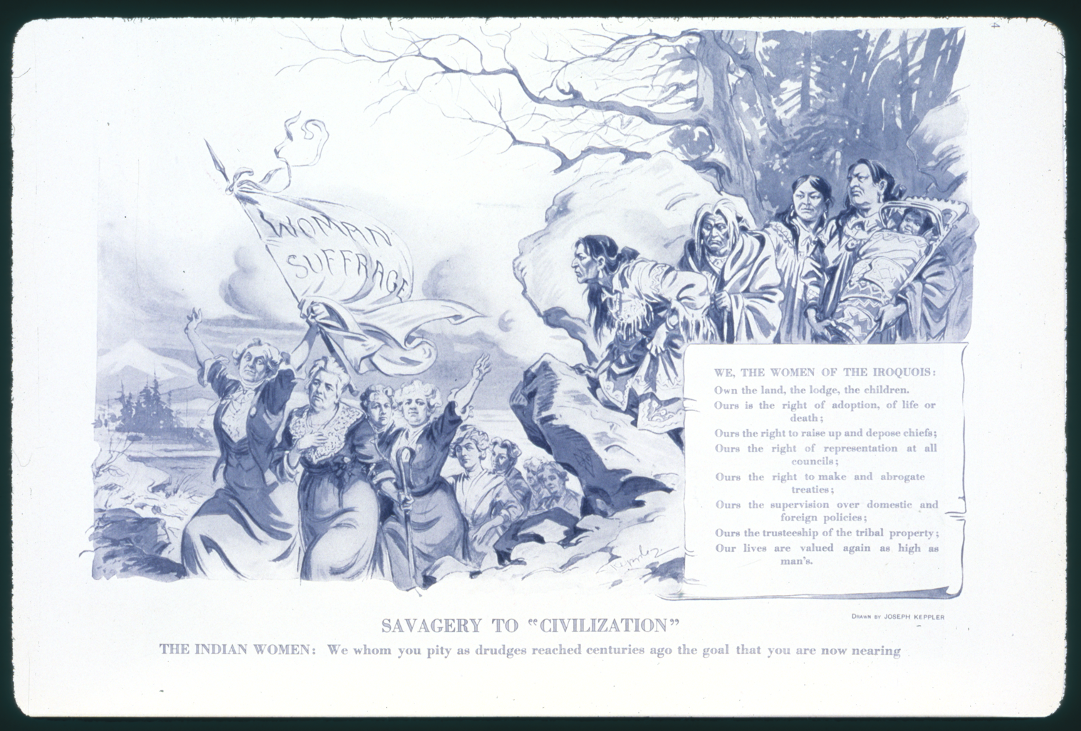
Poster realised by Joseph W. Kepler, held at the Library of Congress.
It was published in 1914 by an influential and widely read American magazine: Puck. It depicts Anna Howard Shaw, Susan Anthony and Elisabeth Stanton parading while being observed and interpellated by a group of indigenous women.
Their address reads like this:
“We, the women of the Iroquois
Own the land, the lodge, the children
Ours is the right to adoption, life or death;
Ours is the right to raise up and depose chiefs;
Ours is the right to representation in all councils;
Ours is the right to make and abrogate treaties;
Ours is the supervision over domestic and foreign policies;
Ours is the trusteeship of tribal property;”
*Notes on the tentative title of the project:
The title quotes a Wendat political thinker and leader, Kandiaronk. It was transcribed and published in 1703 by Louis Armand de Lom d’Arce. The complete quote reads as follows: “Vouloir vivre dans les Païs de l’argent & conserver son ame, c’est vouloir se jeter au fond du lac pour conserver sa vie.” (Wanting to live in the culture of money & preserving your soul is like wanting to throw yourself deep into a lake so as to preserve your life). [Supplément aux voyages du Baron de Lahontan, où l’on trouve des dialogues curieux entre l’auteur et un sauvage de bon sens qui a voyage. 1703]
[i] [The Iroquois, or Haudenosaunee, are a confederation of Amerindian peoples (Mohawk, Oneida, Onondaga, Cayuga, Seneca and from 1722 Tuscarora) who have lived ancestrally in present day Canada and USA].
[ii] Excerpt from her biography: https://law.syracuse.edu/deans-faculty/instructors/michelle-d-schenandoah/ See also her project Rematriation: https://rematriation.com/
[iii] Thwaites, Reuben Gold, ed. The Jesuit Relations and Allied Documents. 73 vols. Cleveland: Burroughs Brothers Publishers, 1899. See also Karen Anderson. Chain Her by One Foot. The Subjugation of Native Women in Seventeenth-Century New France. Routledge. 1991.
[iv] Barbara Alice Mann. Iroquoian Women: The Gantowisas. Peter Lang. 2000.
[v] David Graeber y David Wengrow, The Dawn of Everything. A New History of Humanity. Nueva York, Farrar, Straus and Giroux. 2021.
Illustration realised by Joseph W. Kepler, held at the Library of Congress.
It was published in 1914 by a widely read American magazine: Puck. It depicts Anna Howard Shaw, Susan Anthony and Elisabeth Stanton parading while being observed and interpellated by a group of indigenous women.
Illustration realised by Joseph W. Kepler, held at the Library of Congress.
It was published in 1914 by a widely read American magazine: Puck. It depicts Anna Howard Shaw, Susan Anthony and Elisabeth Stanton parading while being observed and interpellated by a group of indigenous women.